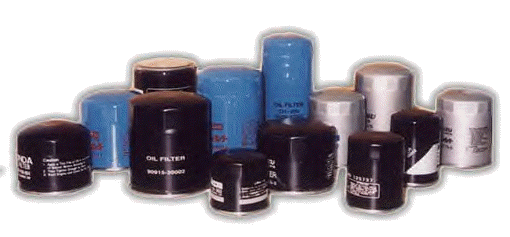
Oil filter - as the name implies - is a filter designed to remove contaminants from engine oil, transmission oil, lubricating oil, or hydraulic oil.
Oil filters are used in many different types of machinery. Of our interest in particular is the use of the oil filter in internal-combustion engines in motor vehicles.
Other vehicle hydraulic systems, such as those in automatic transmissions and power steering, are often equipped with an Oil Filter of some type as well.
While in this article we will direct our discussion primarily to the Automotive Engine Oil Filter application, where the filtration of Motor Oil is utilized.
However, the same concepts apply no matter what the end use of the Oil Filter is or which fluid is being filtered .
Motor oil has a number of big jobs:
lubricates internal parts
helps cool the engine by transferring heat
seals piston ring - cylinder bore interface
absorbs contaminants
suspends wear particles
suspends soot that forms as a result of combustion.
Some contaminants go into suspension and some are chemically grabbed by the additives.
Additives constitute up to one-fourth of Motor Oil's makeup by volume.
Acting by itself, oil would eventually become saturated with contaminants and allow the internal parts to wear. That is one reason why we have filters in all modern engines.
History
Initially early automotive engine designs did not use any oil filtration.
That was OK in the days when oil was dumped every 500 to 2,000 miles, or if the engine burned or leaked enough oil during normal operation that almost
constant replenishment with new oil compensated for any accumulated
"dirt".
The development of pressure lubrication brought about a need for some type of filtration to protect the oil pump from damage and excessive wear.
At first only simple wire meshes or screens were used in the oil pump intake, some were permanent, while some designs permitted removal and periodic cleaning. In most cases the "oil filter" was reusable after cleaning, usually in kerosene.
Ernest Sweetland and George Greenhalgh invented the modern oil filter in 1923, they were granted a patent in 1929 and
named the new product "Purolator" - a combination of the words: "PURE OIL LATER."
The new oil filter was incorporated into the lubricating system AFTER the oil pump and BEFORE the oil flowed into pressure lubricated bearings of the
engine.
In 1924 first full pressure lubrication system, with an oil filter, became available on a high volume production engine.
The early oil filters used on cars were low performance and not really effective.
Many successful and popular engine designs (VW, FIAT) did not use any oil filters until 1970's.
Some engines used oil filters ONLY in "by-pass" and not in main flow of pressurized oil.
The first use of a full flow oil filter on mass production vehicles occurred in 1946.
The "spin-on" oil filter design was introduced in 1950's.
During 1960's, reusable passenger car oil filters were replaced with more convenient "spin-on" disposable oil filters.
Improved full flow oil filters became available from 1964 to 1967.
Further improvements were made from 1968 to 1971 and "spin-on" oil filters were almost universally used on all US and most European and Japanese
engine designs.
As engine build tolerances got tighter and engines became faster revving and oil stayed in for longer period, filtration became a must.
All automotive engines, whether gasoline or diesel, now come with standard oil filters of some kind.
Design
Most oil filters look simple, but they are the object of continuing research and development to make them work better.
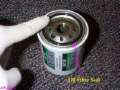
Physically, "spin-on" oil filter resembles a metal can that houses varying types of Filter Media. These are the materials that capture organic or
inorganic contaminants as oil flows through.
Organic contaminants include bacteria and oxidized petroleum that form gross
sludge.
Inorganic contaminants consist of dust that is ingested into the engine, along with trace amounts of wear metals from bearings, cylinder walls and other
internal parts.
Materials
The filter media materials have changed over the years also.
Early designs used steel wool, wire meshes, metal screens, etc.
Latter bulk cotton or various woven fabrics like linen were used.
When disposable filters became popular, cellulose and papers were used to minimize production costs.
Finally "synthetic" media oil filters were introduced where special man made fibers are utilized.
Fiberglass and metal fabrics are also sometimes used for oil filtration.
Today, most low-cost disposable spin-on oil filters use cellulose filter media. Better quality oil filters use synthetic media, while top end oil filter
use "MicroGlass" or extremely fine metal mesh.
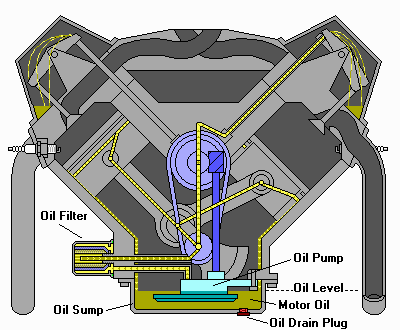
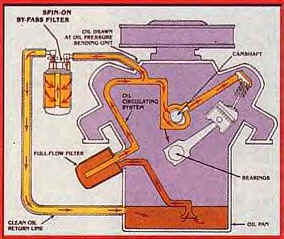
Oil is pumped from the oil sump by oil pump through the oil filter and then distributed by oil passages through out the engine to the bearing surfaces that
need lubrication. Other less critical areas that do not need a pressurized oil
are lubricated and cooled by oil splash - for example: valve stems and
valve guides.
Typical Oil system of American V-8 Engine
Oil Filter
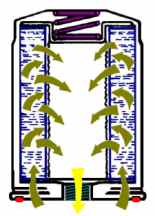
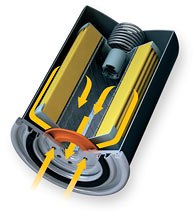
The oil enters the oil filter under pressure through the holes on the perimeter of the base plate.
The "dirty" oil then passes through the filter media where it is
"cleaned".
It then flows through the central tube and back into the engine oil passages
through the usually threaded hollow center mounting stud.
Oil Filter internal Flow Diagram
BASE GASKET
The only thing that holds the "spin-on" Oil Filter to the engine and keeps the oil from leaking is the Base Gasket (shown in above picture in red).
Same vehicles, notably BMW, Mercedes-Benz and many motorcycles use a "cartridge" oil filters, which are essentially ONLY the
"inners" of a "spin-on" oil filter without the outer can.
The operation of the filter is the same, but the re-usable outer housing is usually held to the engine by mounting bolts and thus is considered
"safer" since the retainment of the housing does NOT depend ONLY on the base gasket tension.
If you realize that oil is under pressure ranging from 5 PSI to as much as 100 PSI depending on engine type and design, and that most engines pump oil at
rates exceeding a gallon per minute, you can quickly understand that if the integrity of the base gasket is lost, ALL the oil in the engine will be LOST in
but few minutes. Result of course is a permanent if not catastrophic engine failure, no matter how good your oil may have been. If there is no oil left in the engine, engine will fail!
The base gasket is therefore the MOST important part of the "spin-on" oil filter design.
The gasket will deteriorate with time, more than with mileage.
It will either harden or soften, in either case the gasket tension that holds the filter to the engine is relieved. Engine vibration will "unscrew" the
filter, and ALL the oil will be lost.
The quality and material of the base gasket is what determines for how long a filter could or should be used.
The low cost oil filters that cost few dollars and are used by quick oil change outfits and sold in discount stores definitely should not be used for more than the usual recommendation of 3-month/3,000-mile interval, irrespective of what oil do you use.
The Base Gasket on low cost Oil Filter is perhaps worth only few pennies, and therefore not designed or intended for long term service. It is especially failure prone in both Low and High Temperature extremes.
More premium or OEM oil filters that cost much more can be utilized safely for the maximum oil filter change interval
that is specified by the OEM.
Only a specialty oil filters like SynLube™ MicroGlass™Long Life Oil Filters are specially
engineered to be used for interval ranging from 2 years to 5 years without change. The special Viton base gasket that is
used in this Long Life Oil Filter costs by itself much more than a complete typical bargain spin on Oil Filter.
Filter media can be made of cellulose or fibrous materials, or synthetic
materials designed especially for this purpose. Media in an engine's primary
filters pull out particles as small as 25 to 30 microns (a typical average
human hair is about 45 to 70 microns in diameters). Secondary filters do better
- down to 5 or 10 microns - but also add restriction to the flow.
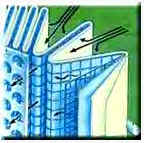
SynLube™ MicroGlass™ reinforced synthetic
multi-component media
SynLube™ MicroGlass™ Media
1st and 3rd layers with reinforcement fibers (one large fiber shown above)
99% particle removal that are 10 micron in size
98% particle removal that are 7 micron in size
95% particle removal that are 5 micron in size
SynLube™ MicroGlass™ Media 2nd layer
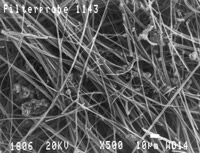
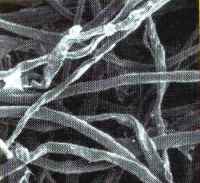
SynLube™ MicroGlass™ technology solves the problem by using special synthetic glass microfibers
(shown above) that are about 10 times
smaller than conventional cellulose filter fibers (shown below). This allows a full flow oil filter to have
above listed performance.
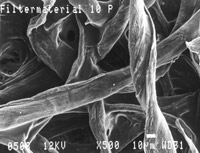
Typical OEM Quality Cellulose Filter Media
Typical OEM Quality
oil filter will remove about 72% of particles in 8 to 10 micron range
Most manufacturers that make low cost filters do not disclose or advertise any data on their products filtration range or efficiency, but research done by General Motors indicates following:
Typical low cost Cellulose media oil filter
will remove about 40% of particles in 8 to 10 micron range
Typical medium priced "Synthetic" media oil filter
will remove about 50% of particles in 20 to 40 micron range
but only about 24% in 8 to 10 micron range
NOTE:
All above shown micrographs are shown at identical magnification and
the WIDTH of the images is about 180 microns. That is about the width of 3
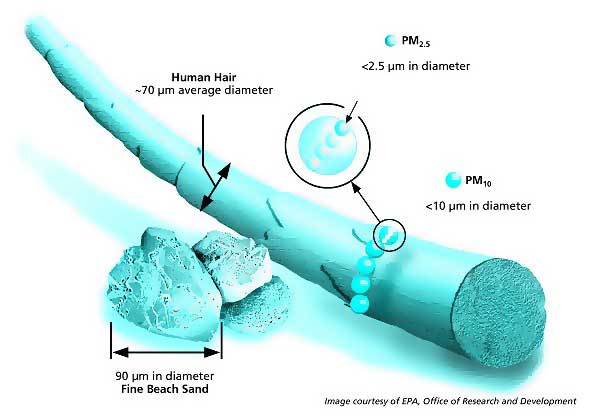
average human hairs, see image below for relative sizes.
Micron
A unit of measure equal to one-millionth of a meter (or one-thousandth of a
millimeter, 0.001 mm, or about 0.000039 inches).
The symbol μm is sometimes rendered as um if the symbol μ cannot be used.
PRIMARY FILTERS
Primary filters are standard on almost all modern engines.
They are also called "full-flow" because 100% of the engine oil passes through the Oil Filter in normal operation.
The filters must work without introducing a lot of restriction to the fluid flow, or else oil will not flow into the engine during cold start-ups.
This is one reason the full-flow filter allows passage of the comparatively small contaminants; trying to catch everything would either restrict the oil
flow or make the filter mechanically very large.
If filer media blockage occurs in the filter, there is a "bypass valve" that opens at specified differential pressure.
This allows oil to go around the filter media and back to the engine. In this situation, lubrication with unfiltered oil is better than none at all.
BYPASS FILTERS
Because PRIAMRY FILTERS do not remove very small particles, on engines that are designed for operation in severe conditions and for long service life an
additional By-Pass Filter is also installed. These filters are also sometimes
referred to as Secondary Filters.
Secondary or By-Pass Filters take a small portion of the normal oil flow, usually less than 10%, and quite often only about 1% and subject it to
additional cleaning. Secondary filters are better known as bypass filters, but they act separately from the primary filter and have nothing to do
with its bypass valves that are components in the Primary Oil Flow.
By-pass Filters were originally sold as a way to extend engine life, but now they can also help extend oil-drain intervals. By-pass Filters can be installed
on most existing engines because they plumb into fittings on the engine block.
Or can be mounted remotely from the engine.
If compact enough they will be mounted on or close to the engine block (which is how engine builders usually do it if they include By-pass Filtration).
Otherwise, they are remotely mounted using hoses and other hardware. There are several types of aftermarket bypass filters.
By-pass Filters are standard on some Heavy-Duty Diesels and optional on others;
they are also readily available as aftermarket products.
When you compare the various types of By-pass Filters, you find that Each has advantages and disadvantages.
But if you are a conservative and change oil at or sooner than the intervals recommended by the engine maker, you need not worry about aftermarket products
at all.
The engine's standard filters will be quite adequate.
Conventional Secondary Filters
Secondary Filters that use Conventional Filter Media, such as Cellulose, are referred to as Conventional. This is because the actual Filter Media
is not any different in materials or function from the Primary Filters, the only difference is that it is designed to filter much smaller particles,
sometimes as small as One Micron. Usually more efficient
Filter Media removes the smaller contaminants, but of course it is far more restrictive to the oil flow, that is why only a small proportion of the oil
flow is directed through the Secondary Filter.
Remote By-Pass Oil Filter installation diagram
Spin-ons (as shown above), look much like standard full-flow filters.
The Filter Media varies with the product, from fibrous, cellulose or synthetic materials to tightly wound cotton string. These By-pass Filters have no moving
parts and some claim extremely high efficiency. As with the Primary Filter, the element has to be changed periodically and frequently.
Unconventional Secondary Filters
Large Stationary canisters whose element media range from fibrous strands to paper toweling. Some hold a gallon or more of oil, which is an advantage
because the greater the volume of oil, the longer it can stay in the engine.
And each time the element is changed, a gallon of fresh oil is added.
But due to limited engine room space in modern vehicles, this type of filter is now seldom utilized.
The Frantz Filter is perhaps the most "famous" of By-pass Filters of this type, and it is still available today. The cost of the complete
"system" when installation costs are added can exceed $400.00 !
Sometimes mechanical or thermal action spins or boils out contaminants. There are hundreds, if not thousands, of Secondary Filter patents
and designs.
However, only few of them have been over the years produced commercially in any significant volume. This is because the cost of such Unconventional Secondary
Filter is usually many times more than the cost of the Conventional Secondary Filter. This is because the Conventional Secondary Filters are made in volumes
of several thousand at a time.
The additional cost and sometimes the difficulty of the installation in engine compartments with limited available space makes these Unconventional Secondary
Filters impractical.
Thermal chamber types which, in addition to passing oil through a filter media, also heat the oil to boil off certain contaminants.
Their makers claim this re-refines the oil (thus the suffix -finer is part of the name of at least two products). It usually
operates on electrical power, which of course consumes energy.
Spinner filters that use centrifuge action to sling out soot and deposit it in a container. The centrifuge is powered by the truck's
compressed air system and revolves on a bearing. The container must be periodically cleaned out and the spinner's condition monitored.
Combination Filters
The newest designs of Oil Filters for Heavy Duty engine applications now combine primary and secondary filtration in separate chambers, but in the same
common housing.
These are used on some recently introduced diesels.
More About Oil Filters
The size and number of filters put on an engine as standard equipment depends on its size and how long its oil will remain in the crankcase before
being changed.
Standard full-flow filters are designed-in by engine makers to cleanse the oil during normal service.
This assumes the oil is changed at normal recommended intervals for the type of
duty the engine and vehicle encounter.
The cleaner the environment and easier the duty, the longer the service interval; the dirtier environments and tougher duties require more frequent oil
and filter changes.
If you run Long Life Oil in your engine for extended intervals (longer than those recommended by OEM ), you may have to change the standard conventional Cellulose Oil Filters more often than the oil.
Or you can use a Primary Oil Filter whose materials are designed to go a longer calendar time and engine run hours.
You can also use a Secondary By-pass Filter, whose additional cleaning action eases the burden on the Primary Filter.
Although the use of magnets to collect iron particles from engine oil seems simple, merely placing the magnet in the oil pan does not provide sufficient
effect.
Because of the characteristics of motor oil, metallic particles in moving oil will not be attracted by the magnet unless there is direct contact with the
magnet surface. When oil is stationary, only the particles immediately surrounding the magnet are attracted.
A magnet placed in the differential gear box will have more opportunity to attract metallic particles. This is because the Gear Oil is splashed around by the rotating gears.
In automatic transmission fluid, iron particles are assimilated more efficiently if the magnet is placed near the oil cooler intake
rather than merely placing it on the oil pan. Usually in many automatic transmissions there is an existing magnetic device designed to remove particles from automatic transmission fluid (ATF).
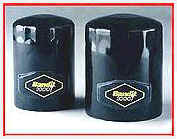
Oil Filters with Bandit
Magnet Units Installed
The route that engine oil takes through an oil filter is the ideal location for a particle-attracting magnet.
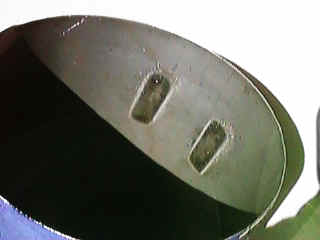
Detail of ferrous metal wear particles attracted
to the inside of the oil filter housing by the Exterior Magnets
Magnets with alternating opposing poles of the magnet (N=North and S=South)
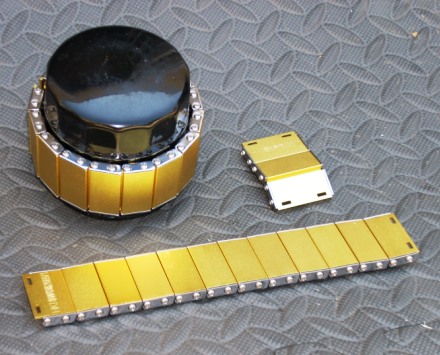
are most effective in particle removal. The "new" SynLube™ UniMag™ Filter Magnets are of such a construction.
Fns
Oil Filter with UM-16 UniMag Filter Magnet attached
UM-3 and UM-12
Unfortunately many marketers of Filter Magnets make unsubstantial as well as ridiculous claims about Magnets:
The magnetic forces stabilize the oil molecules
The longer the exposure to the magnetic field, the more effective the acquisition of metallic particles becomes.
Increases fuel mileage
Reduces oil consumption
Reduces Emissions
Increases Engine power
Well, all above claims are FALSE and IMPOSSIBLE, the only thing that magnets are good for is the removal of ferrous i.e. magnetic particles.
The only additional benefit is derived chemically but ONLY in a low quality lubricants.
This can in turn extend the service life of a lubricant with ineffective or marginal anti-oxidant.
Here is how it works:
Sub-micronic finely distributed iron particles act as a co-catalysts in oxidation of petroleum molecules
Removal of these fine iron particles from oil circulation, reduces the oxidation rate and therefore extends lubricant service life.
No special "MAGNETIC MAGIC" performed here, just a simple chemical reality!
WHEN TO CHANGE Oil Filter ?
When is the right time to change oil and filters?
Engine builders publish recommended intervals, often using charts that factor in conditions and mileage or hours. You will never go wrong if you adhere to
these recommendations faithfully, or change oil even more often. It might also make you feel better that you are regularly replacing "dirty" oil with
clean oil, and that has been both believed and advertised for many years as: "How things should be done".
The "myth" of the infamous 3,000 mile or 3 month Oil Change Interval is the adage still promoted by the Oil Companies
and the Quick Oil Change Industry as well as many Independent Mechanics.
But is it the RIGHT thing to Do ?
Fact is, a variety of vehicle chassis components are designed to run longer and longer without any regular attention. These are available as options on new
commercial trucks, and some can be retrofitted to existing older units.
On Light-Duty vehicles such as: Passenger Cars, Vans, Pick-Ups and SUVs; chassis components that used to in the past require Lube and Adjustment are now
almost universally on all modern vehicles replaced with systems that are designed to last the "Useful Life" of the vehicle without any maintenance an are
generally "Sealed and Lubed for Life". Thus not only any maintenance is not "required" it is not even "possible" !
The Motor Oil and Motor Oil Filter Change, however still remains the most common and most frequent Periodic Maintenance Service = PMS.
While almost all OEM recommend Motor Oil
Change Intervals that are much longer than those recommended by the Oil Companies and the Quick Oil Change Industry as well as many
Independent Mechanics, if Oil of specified API or ILSAC
Quality is used, there are also available even more advanced products.
Among these products are oils and filters that can safely extend drain intervals. This can save:
Because You won't have to buy Oil and Filter as often.
If the vehicles are used in commercial service, they stay out longer, earning money.
Even if the truck or van still comes in at the old interval for
a "B" or "C" check, the vehicle needs lot less time in the shop while being serviced.
Keeping oil in the engine longer also reduces the cost of legally disposing of drain oil.
This becomes increasingly important as ever-stricter federal, state and local environmental regulations go into effect.
Reduced NET Oil Consumption due to Extended Oil Drains of course reduces the volume of Crude Oil that needs to be imported.
It is a fact that oil itself does NOT wear out!
But it can DOES get "contaminated" and "damaged" or "depleted".
The contamination is from Petroleum Oil degradation due to oxidation and formation of sludge and other organic compounds as well as contamination due to
suspension of wear particles in the oil.
The damage is caused by abnormally high oil temperatures, and both accelerates the bulk oil oxidation rates as well as causes chemical reactions to occur that
permanently damage the additive package in the oil.
Over time also the additive package becomes depleted as the chemicals absorb contaminants.
If the oil is not "fried" or over-heated and the additive package remains intact, oil can be made to last far longer than many people are used to
believe.
Some vehicle owners using new products "never" change their engine oil!
But they do a "partial" change each time they add fresh "make-up" oil to make up for what is consumed in normal engine operation and also to replenish small
amount that is removed during a change of oil filter elements.
If you want to extend the oil-change interval to save time and money, you need to develop a program to do it safely. The correct oil and proper filtration are
part of this. So, probably, also is Oil Analysis.
Responding to demands for reduced maintenance, engine makers have lengthened the recommended distances allowed for some over-the-road truck engines. Usually
these involve larger oil capacity (Up to 50 Quarts) and more filtration (Two Filters and/or By-pass Filter System).
One newer engine model has an advertised oil change interval of 50,000 to 65,000 miles between intervals, and that includes the standard
primary-secondary oil filter and synthetic heavy duty diesel motor oil.
Even standard engines can go well beyond the basic OEM recommended distances.
This is possible with a carefully monitored program that utilizes high quality lubricant such as SynLube™ Lube‑4‑Life® Motor Oil and super premium quality oil filter such as SynLube™ MicroGlass™Long-Life Motor Oil Filter as well as the UniMag™ Oil Filter Magnets.
OIL FILTERS - Production and Consumption
About 400 million oil filters are manufactured in the USA Each year, and about another 25 million are imported, resulting in total annual oil filter
sales of about 425 million.
About 45% of passenger car oil filters are sold to DIY (do-it-yourself) oil changers.
OIL FILTER - Recycling
Recycling rate of used oil filters is increasing, as a result of tough new regulations, that in some states declare used oil filters as hazardous waste,
unless they are recycled.
However, less than 25% of all the oil filters sold are properly recycled.
Experts estimate that a 100% recycling would allow recovering of 160,000 tons of steel and over 17.8 million U.S. Gallons of oil (67 million Liters).
Authorities estimate that as little as 1% to 2% of DIY generated oil filters are properly recycled.
Filter Manufacturing Council reports that in 1994 from the 420 million filters sold, more than
56 million or about 13% were recycled in the USA. In the first half of 1995 the same company respondents had recycled 44 million oil filters or about 21%.
CONCLUSION
Want the best available Oil Filter for your vehicle ?
You can buy them from SynLube Incorporated just click the link button below: