 SynLube™ Lube‑4‑Life®
SynLube™ Lube‑4‑Life®
Viscosity is the measure of the internal friction in a liquid or the resistance to a flow.
Low viscosity fluids flow easily (water, alcohol);
High viscosity fluids pour slowly (molasses, cold honey,
etc.).

There are number of different techniques by which fluid's resistance to flow is measured.
Because Viscosity changes with temperature and sometimes also with pressure, it is also important that when different fluids are compared that the measurements were conducted under the same temperature and pressure conditions.
The common metric unit of absolute viscosity is the poise.
For convenience, the CentiPoise (cP) [one one-hundredth of a poise] is the unit customarily used.
Laboratory measurements of viscosity normally use the force of gravity to produce flow through a capillary tube (viscometer) at a controlled temperature. This measurement is called kinematic viscosity.
The more customary unit is the centistoke (cSt) [one one-hundredth of a stoke].
We are accustomed to the notion of friction as a force that is exerted opposite to that which brings about motion when one solid moves in contact with another.
Such friction force tends to slow and eventually stop movement, unless the propulsive force is maintained so that the friction force is equalized.
There is also a friction where solid moves through liquid, as when ship
plows through water.
The ship once set in motion will come to halt; unless the propulsive force is
maintained here too. Although water seems so smooth and lacking any projection
to catch the ship, water nevertheless absorbs enough energy when it is pushed
apart by the ship to eventually stop it.
This friction arises from the fact that it is necessary to expend energy (power) to pull the water apart against its own cohesive forces in order to make room for the ship to pass through it.
The energy expanded varies greatly with the shape of the object that passes through the fluid.
If the fluid is pulled apart gently and gradually, and then brought back even more gently and gradually, then the energy needed to be expanded is minimal.
Such action is possible only by object that is of teardrop shape.
By contrast if the fluid is pulled apart abruptly in such a way as to force it into eddies and other turbulence, such as by cube, the maximum energy will have to be expanded to move the cube through the fluid.
The friction between a moving solid and a surrounding liquid increases with velocity, so no matter how streamlined the object may be, eventually a terminal velocity will be reached and thus and object falling through the water accelerated by gravitational pull, will eventually fall at a constant speed.
Any object will sink faster in fluid of low viscosity such as water, and will sink much slower in a high viscosity fluid such as glycerin.
Viscosity of a fluid can thus be "measured" by the time it takes for object, such as a steel ball bearing, fall through a test tube with oil, for example.

The friction makes itself evident even when the liquid itself is the only substance involved. When any liquid moves, or pours, it does not move all-in-one as a solid does.
Instead, a given portion of the liquid will move relative to a neighboring portion and "internal friction" between these two portions will counter the motion. Where the cohesive forces that impose this internal friction are low, as in water, we are not ordinarily very aware of this. When the cohesive forces are high such as in cold honey, the fluid pours very slowly.
The internal friction for any fluid is higher at low temperature, and much lower at higher temperatures. So honey that was in refrigerator, will barely flow, but once warmed to room temperature will pour easily.
The difference in flow between freezing cold and boiling hot water however is so small as not being perceivable by human senses. However, very sophisticated laboratory equipment can detect the difference.
Where the difference in flow between hot and cold fluid is very small, such fluid is said to have HIGH VISCOSITY INDEX. (High VI)
By contrast honey will be solid at freezing and water like at boiling temperatures, such fluid is said to have LOW VISCOSITY INDEX. (Low VI)
At room temperature water has viscosity of just about ONE CentiPoise, while the common anesthetic - diethyl ether has viscosity of 0.23 CentiPoise or 23 MilliPoise, and glycerol is about 1,500 CentiPoise or 15 Poises.
The unit of viscosity the Poise has been named in honor of French physician Jean Louis Poiseuille (1799-1869), who in 1843 was the first to take time to study viscosity in quantitative manner.
As a physician he was interested in the manner in which blood moved through blood vessels. But his observations proved to be valid for ALL liquids.
For the purpose of lubrication, viscosity has been since the beginnings of Lubrication Engineering held as the most important quality of the Lubricant.
The reason for this is that if the lubricant is too thin, it gets forced out from bearing surface under pressure and poor lubrication occurs, this leads to bearing surface damage.
If the lubricant is too viscous, it either does not flow into the bearing surface, causing lube starvation, and thus certain bearing damage. Or it consumes too much energy, which is then converted to heat and the bearing may be overheated, at which point it can seize due to loss of running clearance.
Therefore oil that is either too viscous or too thin, will cause premature failure of any bearing surface.
The proper viscosity for given application is therefore extremely important.
That is why the first lubricant standard J300 that was developed by SAE in 1911 was Viscosity Classification of Motor Oils, and although this standard was revised and updated many times it is still used today world-wide for Motor Oil applications.
However unlike the exact scientific value of Poise for Absolute Viscosity, the SAE viscosity numbers are "staircase" approximations for KINEMATIC Viscosity.
For example Motor Oil that is measured to have viscosity of 9.5 cSt @ 100°C will be rated as SAE 30, while another Motor Oil that is measured to have viscosity of 12 cSt ( or 26% more viscous ) will also be rated as SAE 30 Motor Oil.
Yet in real life operation 26% difference in viscosity may make difference between engine that will run forever and one that will wear out prematurely.
That is why "stay in grade" over the service life of the Motor Oil is also important!
The SAE J300Standard is only relating to a FRESH UNUSED MOTOR OIL.
As few as 20 hours of operation will change viscosity of pure petroleum oil.
Some oils classified as SAE 30 when Fresh will with use and temperature shear and thin out to SAE 20 or below, while some other oils will oxidize and sludge up to become much more viscous like SAE 40 or even SAE 60 !
The "best" motor oil will be SAE 30 when fresh and SAE 30 when drained out after its use, this is termed as "Stay in Grade".
Motorists make the common mistake that every SAE 30 oil is the same in performance, but the reality, however, is quite different.
Even more drastic differences in viscosity for fresh and used oils can be observed in multi-viscosity or multi-grade oils such as SAE 5W-30.
The SAE J300 Standard for viscosity classification of Motor Oil therefore should not be confused with any level of quality or long term performance.
API Service Classifications are used to distinguish Motor Oil performance levels and are based on specific engine and laboratory tests.
No matter what oil you use for any purpose the ideal viscosity that provides the ultimate lubrication, that is TOTAL bearing surface separation, and at MINIMUM power that is consumed by the lubricants viscosity (MINIMUM TEMPERATURE RISE) occurs ONLY at ONE combination of:
Under ALL other combinations of the three factors, the lubricant is NOT IDEAL.
Some lubricants, due to much higher than normal viscosity index, can have more advantageous performance over much wider range of TEMPERATURE, SPEED and LOAD, than others and therefore can be used more universally in wide range of applications.
That is why some lubricants such as single grade SAE 30, must be changed to SAE 20 when operating temperature is reduced or to SAE 40 or SAE 50 when the operating temperature is increased.
So thicker more viscous oil is needed when engine is operated at higher temperature such as high summer heat.
Similarly the proper viscosity depends on Load, the higher the load the thicker or higher SAE number is required. Therefore on highly loaded engine designed to use SAE 30 oil under normal operation; SAE 40 or SAE 50 should be utilized.
Speed however has the opposite effect, when engine designed to run at 2,000 RPM is constantly run at 6,000 RPM but at the same load, the SAE 30 oil should be substituted with SAE 20 oil. Higher operating speed requires thinner or lower viscosity lubricant.
It is possible in some applications that the increase in Load can be just offset by the increase in Speed and then the same oil such as SAE 30 that is just right for NORMAL operation will be also JUST RIGHT for the new HIGH LOAD and HIGH SPEED regime.
"Old" truckers are well aware of this from experience, they get much better and longer engine life when running in lower gear up-hill. Extra LOAD is imposed on the engine by climbing uphill (lifting cargo weight against the pull of gravity requires more power therefore the engine LOAD is increased = this requires thicker lubricant), this can be balanced by running engine at much higher RPM (this requires thinner lubricant).
The alternative of running uphill in low gear, that is at slow engine speed and increased load would surely require increase in motor oil viscosity or else almost certain engine damage would result.
It would be rather inconvenient to change motor oil before and after every major hill on the Interstate. Therefore changing gears is much more feasible.
Thinner motor oils such as SAE 5W-20 or even SAE 0W-20 are becoming more popular these days and were specified by some OEM's (FORD & HONDA) on new cars since 2001 Model Year.
Although these oils are promoted as "energy conserving" they generally trade a gain of less than 0.1 MPG in Corporate Average Fuel Economy (CAFE) for shorter useful engine life.
FORD which has previously designed cars to have 10 year or 150,000 miles life has reduced the mileage life expectation to "beyond 100,000 miles" on vehicles that are operated on SAE 5W-20 Motor Oil.
HONDA only claims "useful life" as 7-years or 70,000 miles in EPA certifications for their CIVIC which uses SAE 5W-20 Motor Oil, while the previous model year that utilized SAE 5W-30 Motor Oil was certified for 10 year or 100,000 mile durability.
Since both HONDA and FORD Warranty their NEW cars for ONLY 3-years or 36,000-miles the reduction in engine life expectancy is not a factor.
By contrast Mercedes-Benz recommends use of ONLY Synthetic Motor Oil that is at least SAE 5W-40 !
This is a recent increase in recommended viscosity from SAE 5W-30. Apparently customer research indicated that engine longevity is more important to typical MB customer than fuel economy.
Similarly BMW specifies the use of Synthetic Motor Oil that
has a rating of SAE 10W-60!
This is for use in some of their high performance engines.
As a result BMW has to pay annually CAFE fines ranging in
millions of dollars, but they consider this as "cost of doing a business in
USA".
Apparently customer research again indicated that engine reliability is more important to typical BMW customer than fuel economy.
Even more important is the High-Shear High-Temperature MINIMUM specification
in SAE J300.
In tables below you will notice that there are "two" SAE 40
specifications, one with minimum HSHT value of 2.9 cP for Automotive Oils (SAE
0W-40; 5W-40; 10W-40) and the other for Heavy Duty Oils (HDO) (SAE 15W-40;
20W-40; 25W-40; 40).
This double specification is at insistence of heavy duty engine
manufacturers who have required HSHT viscosity limits consistent with good
engine durability in high-load, severe service operation.
HSHT value of 3.7 cP or 27% more viscous oil at 150°C (300°F).
Yes, a 27% increase in viscosity makes a difference between Automotive engine that lasts 100,000 miles and Truck engine that lasts 1,000,000 miles!
When you consider that most Automotive Motor Oils are ONLY 3 cP, while our
SynLube™ Lube‑4‑Life®
Motor Oil has rating of 5 cP, you can readily appreciate why we can claim 300%
to 500% increase in typical Automotive engine durability, and that is with
substantial "safety" reserve!
If you wish to learn more about viscosity, following definitions which are also mirrored in our GLOSSARY should give you more technical know-how than you ever dreamed possible!
The measure of the internal friction or the resistance to flow a liquid.
Low viscosity fluids flow easily (water);
High viscosity fluids pour slowly (molasses).
Measurement of a fluid's resistance to flow. The common metric unit of absolute viscosity is the poise, which is defined as the force in dynes required to move a surface one square centimeter in area past a parallel surface at a speed of one centimeter per second, with the surfaces separated by a fluid film one centimeter thick. For convenience, the CentiPoise (cP) [one one-hundredth of a poise] is the unit customarily used.
Laboratory measurements of viscosity normally use the force of gravity to produce flow through a capillary tube (viscometer) at a controlled temperature. This measurement is called kinematic viscosity.
The unit of kinematic viscosity is the stoke, expressed in square centimeters per second. The more customary unit is the centistoke (cSt) [one one-hundredth of a stoke].
Kinematic viscosity can be related to absolute viscosity by the equation:
cSt = cP * fluid density
In addition to kinematic viscosity, there are other methods for determining viscosity, including:
Since viscosity varies inversely with temperature, its value is meaningless unless the temperature at which it is determined is reported.
The ratio of shear stress to shear rate.
It is a fluid's internal resistance to flow.
The common unit of absolute viscosity is the poise and CentiPoise cP (see viscosity).
Absolute viscosity divided by the fluid's density equals kinematic viscosity.
Absolute Viscosity is the tangential force per unit area of two parallel planes at unit distance apart when the space between them is filled with a fluid and one plane moves with unit velocity in its own plane relative to the other.
Absolute viscosity is also known as "coefficient of viscosity".
Absolute viscosity is typically measured by a rotary viscometers to determine the torque on rotating spindle and so measure the fluid's shear resistance. Changing the rotor (spindle) dimensions and the gap between the rotor and stator wall (container) and the speed of rotation can change the rate of shear.
Examples of rotary viscometers that are used for Absolute Viscosity measurements:
In relation to oils for Automotive applications such as Motor Oil or Gear Oil, the CCS and MRV test equipment at low temperatures is used to determine if the test lubricant does not get too thick to prevent safe engine or transmission operation at low temperatures.
If Motor Oil is too viscous to flow, even if engine can be started, certain mechanical damage will result due to localized oil starvation. In transmissions both manual and automatic, proper shifting may be impaired, affecting safe vehicle operation once vehicle is put in motion.
In the new SI system, it is proposed that values for the Poise be stated as Pascal seconds.
The conversion factor being:
1 Poise equal to 1x10⁻¹ Pa•s.
A common measurement unit is the milliPascal second (mPa•s).
Conversion factors are as follows:
1 centipoise (cP) = 0.01 poise (P)
1 Pa•s = 10 P
1 cP = 0.001 Pa•s = 1 mPa•s
1 Pa•s = 1000 cP
The ratio of shear stress to rate of shear of a non-Newtonian fluid such as lubricating grease, or a multi-grade oil, calculated from Poiseuille's equation and measured in poises.
The apparent viscosity changes with changing rates of shear and temperature and must, therefore, be reported as the value at a given shear rate and temperature (ASTM Method D 1092).
Apparent Viscosity is value obtained by applying the instrumental equations used in obtaining the viscosity of a Newtonian fluid to viscometer measurements of a non-Newtonian fluid.
Absolute viscosity of a fluid divided by
its density at the same temperature of measurement.
It is the measure of a fluid's resistance to flow under gravity, as
determined by test method ASTM D 445.
To determine kinematic viscosity, a fixed volume of the test fluid is allowed to flow through a calibrated capillary tube (viscometer) that is held at a closely controlled temperature.
The kinematic viscosity, in centistokes (cSt), is the product of the measured flow time in seconds and the calibration constant of the viscometer.
The kinematic viscosity is the quotient of the dynamic viscosity η and the fluid density ρ,
ν=η/ρ
The physical principle of measurement is based on the rate at which a fluid flows under gravity through a capillary tube viscometer.
Measured in stokes (St) or centistokes (cSt). One centistoke = 0.01 stokes.
The metric unit is square meters per second (m2/s).
| Convert FROM |
Convert TO |
Multiply by |
|---|---|---|
| cSt | m2/s | 0.000001 |
| St | m2/s | 0.000100 |
| cm2/s | m2/s | 0.000100 |
| ft2/h | m2/s | 2.580640 |
| ft2/s | m2/s | 9.290300 |
| in2/h | m2/s | 1.792110 |
| in2/s | m2/s | 6.451600 |
| m2/h | m2/s | 2.777780 |
Conversion factors are as follows:
1 St = 1 x 10⁻⁴m2/s
1 m2/s = 10,000 St
1 cSt = 1 x 10⁻⁶m2/s = 1 mm2/s
1 m2/s = 1,000,000 cSt
Centistokes may be converted to centipoise (cP) by multiplying by the density of the fluid being measured, both measured at the same temperature.
The dynamic viscosity is the viscosity that relates shear stress τ and shear rate du/dz in a fluid:
τ=η du/dz
The viscous shear stress τ is proportional to the shear rate, the dynamic viscosity η being the proportionality factor.
So, thicker oils have a higher viscosity value causing relatively higher shear stresses at the same shear rate.
Dynamic viscosities are usually measured under high shear conditions, for example, the cone on plate or cylinder viscometer in which the viscous shear torque is measured between two cylinders.
The SI derived unit for dynamic viscosity is:
Newton second per square meter (N•s/m2) = 1 Pascal second (Pa•s)
| Convert FROM |
Convert TO |
Multiply by |
|---|---|---|
| cP | Pa•s | 0.00100 |
| P | Pa•s | 0.10000 |
| dyn•s/cm2 | Pa•s | 0.10000 |
| gf•s/cm2 | Pa•s | 98.06650 |
| g /(cm•s) | Pa•s | 0.10000 |
| kgf•s/cm2 | Pa•s | 9.80665 |
| kg/(m•s) | Pa•s | 1.00000 |
| N•s/m2 | Pa•s | 1.00000 |
| poiseuille | Pa•s | 1.00000 |
| lbf•s/ft2 | Pa•s | 47.88030 |
| lbm/(ft•s) | Pa•s | 1.48816 |
| lbm/(in•s) | Pa•s | 17.85800 |
| reyns | Pa•s | 1.48816 |
| slug/(ft•s) | Pa•s | 47.88030 |
| slug/(in•s) | Pa•s | 574.56300 |
Conversion factors are as follows:
1 (N•s/m2) = 1 (Pa•s) = 10 poise (P) = 1 dekapoise (dP)
9.806 65 kg = 1 kgf
An arbitrary scale used to show the magnitude of viscosity changes in lubricating oils with changes in temperature.
Oils with low VI number such as VI=0 ("zero") have high dependence of viscosity change on temperature. They thicken quickly with decreasing temperature, and thin out quickly with increasing temperature.
Oils with high VI number such as VI=200, will still thicken with decreasing temperature but not as rapidly, and also will thin out with increasing temperature, but again not as much as low VI oil.
Calculated VI number can also be "negative"
Tables found in ASTM Method D 2270 are widely used to determine VI number.
However, VI does not tell the whole story -- it only reflects the
viscosity/temperature relationship between temperatures of 40°C and 100°C.
Two lubricants or base oils with the same VI number may perform dramatically different at low temperatures in the -5°C to - 50°C range.
In many cases the temperature dependency is expressed in the Viscosity Index standardized by ISO 2909 / ASTM D2270-226.
Chemical additive that is added to finished lubricants to improve the viscosity index.
Lubricant additive, usually a high-molecular-weight
polymer, that reduces the tendency of an oil to change
viscosity with temperature.
Multi-grade oils, which provide effective lubrication
over a broad temperature range, usually contain V.I. improver.
While Viscosity Index Improver can enhance viscosity index (VI), they can break down under shear or over time, resulting in diminished performance.
The manner in which the viscosity of a given fluid varies inversely with temperature. Because of the mathematical relationship that exists between these two variables, it is possible to predict graphically the viscosity of a petroleum fluid at any temperature within a limited range if the viscosities at two other temperatures are known. The charts used for this purpose are the ASTM Standard Viscosity-Temperature Charts for Liquid Petroleum Products, available in 6 ranges. If two known viscosity-temperature points of a fluid are located on the chart and a straight line drawn through them, other viscosity-temperature values of the fluid will fall on this line; however, values near or below the cloud point of the oil may deviate from the straight-line relationship.
Possessing viscosity. From the Latin word for a sticky species of birdlime
that is a slowly-pouring liquid.
Frequently used to imply high viscosity.
Device for measuring viscosity; commonly in the form of a calibrated capillary tube through which a liquid is allowed to pass at a controlled temperature in a specified time period.
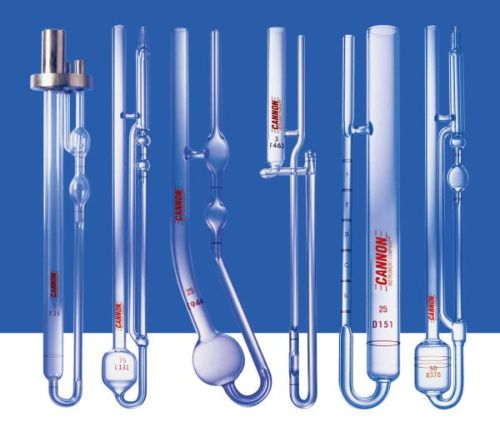
The Society of Automotive Engineers (SAE) is an engineering society founded to develop, collect, and disseminate knowledge of mobility technology.

| SAE Viscosity Grade | Low Temp. Cranking | Low Temp. Pumping | Minimum Kinematic | Maximum Kinematic | Hi-Temp. Hi-Shear |
|---|---|---|---|---|---|
| 0W | 3,250 @ -30 | 60,000 @ -40 | 3.8 | ||
| 5W | 3,500 @ -25 | 60,000 @ -35 | 3.8 | ||
| 10W | 3,500 @ -20 | 60,000 @ -30 | 4.1 | ||
| 15W | 3,500 @ -15 | 60,000 @ -25 | 5.6 | ||
| 20W | 4,500 @ -10 | 60,000 @ -20 | 5.6 | ||
| 25W | 6,000 @ -5 | 60,000 @ -15 | 9.3 | ||
| 20 | 5.6 | 9.3 | 2.6 | ||
| 30 | 9.3 | 12.5 | 2.9 | ||
| 40 | 12.5 | 16.3 | 2.9 | ||
| 40 | 12.5 | 16.3 | 3.7 | ||
| 50 | 16.3 | 21.9 | 3.7 | ||
| 60 | 21.9 | 26.1 | 3.7 | ||
| 5W-50 | 3,500 @ -30 | 30,000 @ -40 | 16.9 | 18.0 | 5.0 |
The SAE 5W-50 rating shown above is for SynLube™ Lube‑4‑Life® Motor Oil.
However, the previous specification has been revised by SAE in December 1999 to one tabulated below.
According to "new" J300 our existing version of
SynLube™ Lube‑4‑Life®
Motor Oil should have been classified as SAE 0W-50, however
our customer research has shown that this unusual classification was "too
radical" and "too scary", so we have decided to retain our
existing rating of SAE 5W-50 that was originated in 1985. This
required slight "thickening" of the lubricant at low temperatures,
achieved by only 2% increase of one of our existing ingredients. By
"missing" the target SAE 0W low temperature viscosity
by
50 cP at -40°C we can "legally" label our lubricant as SAE
5W-50, while for practical purpose offer to our customers cold
performance that "almost matches" SAE 0W motor
oil.
|
SAE Viscosity Grade |
Low Temp. Cranking (mPa.s) max at temp °C |
Low Temp. Pumping (mPa.s) max at temp °C |
Minimum Kinematic (mm2/s) at 100°C |
Maximum Kinematic (mm2/s) at 100°C |
Hi-Temp. Hi-Shear (mPa.s) at 150°C @ 10/s |
|---|---|---|---|---|---|
| 0W | 6,200 @ -35 | 60,000 @ -40 | 3.8 | ||
| 5W | 6,600 @ -30 | 60,000 @ -35 | 3.8 | ||
| 10W | 7,000 @ -25 | 60,000 @ -30 | 4.1 | ||
| 15W | 7,000 @ -20 | 60,000 @ -25 | 5.6 | ||
| 20W | 9,500 @ -15 | 60,000 @ -20 | 5.6 | ||
| 25W | 13,000 @ -10 | 60,000 @ -15 | 9.3 | ||
| 20 | 5.6 | 9.3 | 2.6 | ||
| 30 | 9.3 | 12.5 | 2.9 | ||
| 40 | 12.5 | 16.3 | 2.9 | ||
| 40 | 12.5 | 16.3 | 3.7 | ||
| 50 | 16.3 | 21.9 | 3.7 | ||
| 60 | 21.9 | 26.1 | 3.7 | ||
| 5W-50 | 6,250 @ -35 | 30,000 @ -40 | 16.9 | 18.0 | 5.0 |
The SAE 5W-50 rating shown above is for SynLube™ Lube‑4‑Life® Motor Oil.
The new SAE 16 Viscosity has been approved for inclusion in a new version of the SAE J300 Viscosity Classification that is planned to be published in April 2013.
The SAE 20 Viscosity Grade Minimum Kinematic Viscosity will be increased from the 5.6 mm2 to 6.9 mm2.
The new SAE 16 grade will have minimal impact on the North American engine oil
market, since it is being specified by only one automaker (Honda) for 2013 model
year engines.
However, the advantages in term of fuel economy will undoubtedly encourage other OEMs to evaluate
SAE xW-16 engine oils in the future.
|
SAE Viscosity Grade |
Low Temp. Cranking (mPa.s) max at temp °C |
Low Temp. Pumping (mPa.s) max at temp °C |
Minimum Kinematic (mm2/s) at 100°C |
Maximum Kinematic (mm2/s) at 100°C |
Hi-Temp. Hi-Shear (mPa.s) at 150°C @ 10/s |
|---|---|---|---|---|---|
| 16 | 6.1 | 8.2 | 2.3 | ||
| 20 | 6.9 | 9.3 | 2.6 |
| SAE Viscosity Grade |
Maximum
Temperature for a viscosity of 150,000 cP (°C) |
Minimum Viscosity at (cSt) a 100°C |
Maximum Viscosity at (cSt) a 100°C |
|---|---|---|---|
| ASTM D 2983 | ASTM D 445 | ASTM D 445 | |
| 70W | -55 | 4.1 | -- |
| 75W | -40 | 4.1 | -- |
| 80W | -26 | 7.0 | -- |
| 85W | -12 | 11.0 | -- |
| 80 | -- | 7.0 | <11.0 |
| 85 | -- | 11.0 | <13.5 |
| 90 | -- | 13.5 | <18.5 |
| 110 | -- | 18.5 | <24.0 |
| 140 | -- | 24.0 | <32.5 |
| 190 | -- | 32.5 | <41.0 |
| 250 | -- | 41.0 | -- |
| 70W-90 | -55 | 16.9 | 18.0 |
The SAE 70W-90 rating shown above is for SynLube™ Lube‑4‑Life® MT Gear Oil.
International Standards Organization
This organization which is worldwide in scope sets standards and classifications for lubricants.
An example is the ISO viscosity grade system.
international system, approved by the International Standards Organization
(ISO),
for classifying industrial lubricants according to viscosity.
The ISO viscosity classification is recommended for industrial applications.
The reference temperature of 40 °C represents the operating temperature in machinery.
Each subsequent Viscosity grade (VG) within the classification has approximately a 50% higher viscosity, whereas the minimum and maximum values of each grade ranges ±10% from the mid point.
The viscosity at different temperatures can be calculated using the viscosity at 40°C and the viscosity index (VI), which represents the temperature dependency of the lubricant.
Each ISO viscosity grade number designation corresponds to the mid-point of a viscosity range expressed in centistokes (cSt) at 40°C.
For example:
Lubricant with an ISO grade of 32 has a viscosity within
the range of 28.8 to 35.2 cSt, the mid-point of which is 32.
(see Table below)
Viscosity range expressed in centistokes (cSt) at 40°C and apporximated by SUS.
| ISO # | Mid-Point | Minimum | Maximum | SUS |
|---|---|---|---|---|
| 2 | 2.2 | 1.98 | 2.42 | 32 |
| 3 | 3.2 | 2.88 | 3.52 | 36 |
| 5 | 4.6 | 4.14 | 5.06 | 40 |
| 7 | 6.8 | 6.12 | 7.48 | 50 |
| 10 | 10 | 9.0 | 11.0 | 60 |
| 15 | 15 | 13.5 | 16.5 | 75 |
| 22 | 22 | 19.8 | 24.2 | 105 |
| 32 | 32 | 28.8 | 35.2 | 150 |
| 46 | 46 | 41.4 | 50.6 | 215 |
| 68 | 68 | 61.2 | 74.8 | 315 |
| 100 | 100 | 90 | 110 | 465 |
| 150 | 150 | 135 | 165 | 700 |
| 220 | 220 | 198 | 242 | 1000 |
| 320 | 320 | 288 | 352 | 1500 |
| 460 | 460 | 414 | 506 | 2150 |
| 680 | 680 | 612 | 748 | 3150 |
| 1000 | 1000 | 900 | 1100 | 4650 |
| 1500 | 1500 | 1350 | 1650 | 7000 |
The SAE 5W-50 SynLube™ Lube‑4‑Life® Motor Oil is rated ISO VG 100.
The SAE 70W-90 SynLube™ Lube‑4‑Life® Gear Oil is rated ISO VG 120.
Saybolt Universal Seconds is a measure of lubricating oil viscosity in the oil industry.
The measuring apparatus is filled with specific quantity of oil or other fluid and its flow time through standatized offrice is measured in Seconds.
Fast flowing fluids (low viscosity) will have low value; Slow flowing fluids (high viscosity) will have high value.
The efflux time in seconds required for 60 milliliters of a petroleum product to flow through the calibrated
orifice of a Saybolt Furol viscometer, under carefully
controlled temperature, as prescribed by test method ASTM D 88.
The method differs from Saybolt Universal viscosity only in that the viscometer has a larger
orifice to facilitate testing of very viscous oils, such as fuel oil (the word
"Furol" is a contraction of "fuel and road oils").
The Saybolt Furol method has largely been supplanted by the kinematic viscosity method.
A measure of viscosity. The ratio of the time of flow of 200 ml of the liquid tested, through the viscometer devised by Engler, to the time required for the flow of the same volume of water gives the number of degrees Engler.
method for determining the viscosity of petroleum products; it is widely used in Europe, but has limited use
in the U.S.
The method is similar to Saybolt Universal viscosity;
viscosity values are reported as "Redwood seconds."
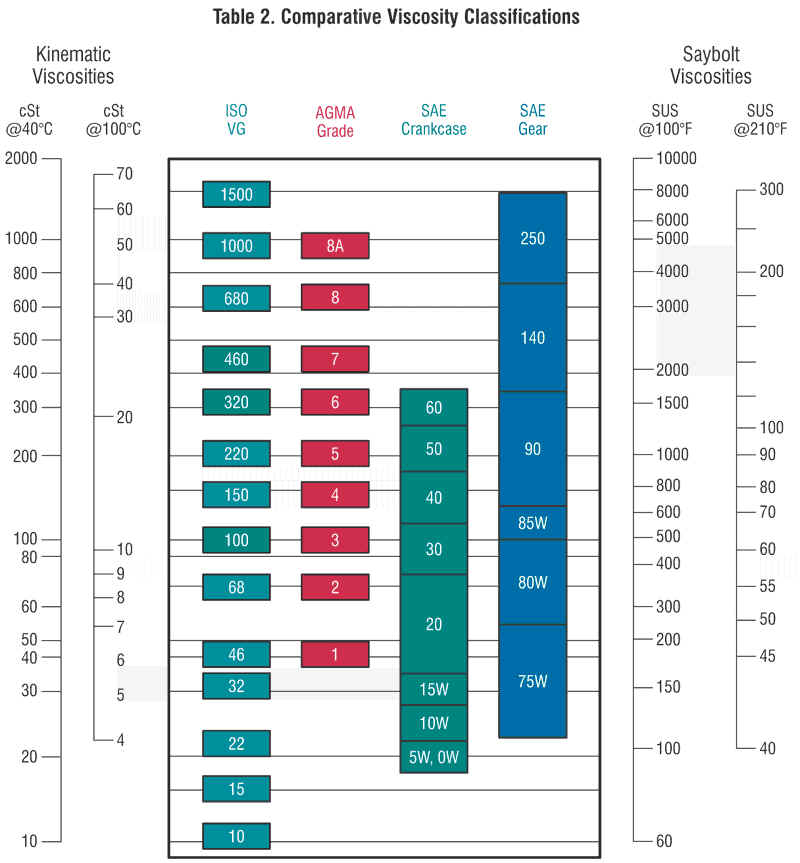
Due to the fact that there are number of differing Viscosity measuring standards it is sometimes confusing to determine what is the viscosity of fluid in a viscosity system of interest if the viscosity is quoted in units used in another viscosity system.
The chart below gives approximate equivalence of values for a typical conventional fluids.
A Newtonian fluid can be described as a fluid that maintains constant viscosity across all shear rates (shear stress varies linearly with shear rate).
These fluids are called Newtonian because they follow the original formula established by Sir Isaac Newton in his Law of Fluid Mechanics.
Some fluids, however, don't behave this way.
In general, they are called non-Newtonian fluids.
A group of non-Newtonian fluids referred to as thixotropic are of particular interest in used oil analysis because the viscosity of a thixotropic fluid decreases as the shear rate increases. The viscosity of a thixotropic fluid increases as shear rate decreases. With thixotropic fluids, set-time can increase apparent viscosity as in the case of grease.
Fluid whose viscosity does not change with rate of flow.
Fluid whose viscosity does change with rate of flow.
Generally speaking, a fluid is non-Newtonian if it is comprised of one substance suspended (but not chemically dissolved) in a host fluid.
For this to happen, there are two basic categories, emulsions and colloidal suspensions.
An emulsion is the stable physical coexistence of two immiscible fluids. Mayonnaise is a common non-Newtonian fluid, comprised of eggs emulsified into oil, the host fluid. Because mayonnaise is non-Newtonian, its viscosity yields with applied force, making it easy to spread.
A colloidal suspension is comprised of solid particles stably suspended in a host fluid.
Many paints are colloidal suspension. If the paint was Newtonian it would either spread easily but run if the viscosity is low, or spread with great difficulty and leave brush marks, but not run if the viscosity is high. Because the paint is non-Newtonian, its viscosity yields under the force of the brush, but returns when the brush is taken away. As a result, paint spreads with relative ease, but doesn't leave brush marks and doesn't run.
SynLube™ Lube-4-Life® Lubricants are non-Newtonian, as a result they flow easily (as low viscosity oil would) but create "thicker" oil film and "stick" to parts (as high viscosity oil would).
If one were to measure the absolute viscosity of one of these commonly encountered emulsions or colloids described above with a variable shear rate absolute viscometer (for example, ASTM D4741), the measurement would decrease as the shear rate increases, up to a point of stabilization.
If one were to divide this stabilized absolute viscosity by the specific gravity of the fluid to estimate the kinematic viscosity, the calculated value would differ from the measured kinematic viscosity.
This is because the equations in apply to Newtonian fluids only, not non-Newtonian fluids described above, which is why this discrepancy in viscosity measurement occurs.
The absolute and kinematic viscosities of a Newtonian fluid are related as a function of the fluid's specific gravity.
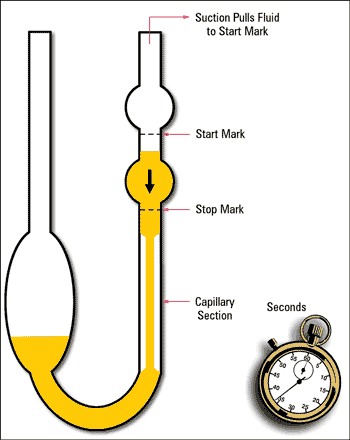
Consider the apparatus in Figure above, the bulb that contains the sample oil, which is released when the vacuum is eliminated, then produces a head of pressure that drives the oil through the capillary tube. Can one assume that all fluids will produce the same head of pressure? No, the pressure is a function of the fluid's specific gravity, or weight relative to the weight of an identical volume of water.
Most hydrocarbon-based lubricating oils typically have a specific gravity of 0.85 to 0.90.
However, this can change over time as the oil degrades or becomes contaminated (glycol, water and wear metals for example), which produces a differential between absolute and kinematic viscosity measurements.
In the interest of economy, simplicity and the fact that new lubricant test procedures are commonly borrowed for used oil analysis, the kinematic viscosity of the oil is typically the measured parameter used for trending and making lube management decisions.
However, in certain cases this may be introducing needless errors in determining the viscosity of an oil.
The problem can be reduced to simple mathematics.
As the viscosity equations suggest, the absolute and kinematic viscosity are related as a function of the oil's specific gravity.
If both the viscosity and specific gravity are dynamic, but only one is measured, an error will occur, and the kinematic viscosity will not provide an accurate assessment of the change in the fluid's absolute viscosity, the parameter of interest. The amount of error is a function of the amount of change in the unmeasured parameter, the specific gravity.
The absolute and kinematic viscosities of a Newtonian fluid are related as a function of the fluid's specific gravity.
As fluids are heated up they expand, and thus their specific gravity is reduced, this in turn of course affects the viscosity.
While some fluids, like water for example, have minimal change in viscosity from Cold to Hot, petroleum products exhibit much greater change in viscosity due to temperature that far exceeds the change in their specific gravity.
The differences in the molecular structure of differing petroleum crudes give them this vastly different behavior.
See Viscosity Index
Coefficients of cubical or volumetric thermal expansion of some common liquids are indicated below:
| Liquid | Volumetric Coefficient of Expansion | |
| (1/K, 1/°C) | (1/°F) | |
| Acetic acid | 0.00110 | 0.00061 |
| Acetone | 0.00143 | 0.00079 |
| Alcohol, ethyl (ethanol) | 0.00109 | 0.00061 |
| Alcohol, methyl (methanol) | 0.00118 | 0.00066 |
| Ammonia | 0.00245 | 0.00136 |
| Aniline | 0.00085 | 0.00047 |
| Benzene | 0.00125 | 0.00069 |
| Ether | 0.00160 | 0.00089 |
| Ethylene glycol | 0.00057 | 0.00032 |
| Freon refrigerant R-12 | 0.00260 | 0.00144 |
| n-Heptane | 0.00124 | 0.00069 |
| Isobutyl alcohol | 0.00094 | 0.00052 |
| Gasoline | 0.00100 | 0.00056 |
| Glycerin (glycerol) | 0.00050 | 0.00028 |
| Kerosene, jet fuel | 0.00100 | 0.00056 |
| Mercury | 0.00018 | 0.00010 |
| Methyl alcohol | 0.00119 | 0.00066 |
| n-Octane | 0.00114 | 0.00063 |
| Motor Oil (unused engine oil) | 0.00070 | 0.00039 |
| Olive oil | 0.00070 | 0.00039 |
| Paraffin oil | 0.000764 | 0.00042 |
| Petroleum | 0.00100 | 0.00056 |
| n-Pentane | 0.00158 | 0.00088 |
| Phenol | 0.00090 | 0.00050 |
| SynLube™ | 0.00140 | 0.00078 |
| Toluene | 0.00108 | 0.00060 |
| Turpentine | 0.00100 | 0.00056 |
| Water | 0.000214 | 0.00012 |
NOTE:
SynLube™ Synthetic Lubricants due to their colloidal content have thermal expansion rate that is about twice as much as that of conventional Motor Oil.
SAE 0W-60 but it is not available, yet !
Theoretically the best possible SAE Viscosity rating is 0W-60 , but only small experimental quantities of such lubricants were ever produced.
The NASA SynLube™ with colloidal Silver, was rated SAE 0W-60, but it sold for $90.00 per Liter, therefore it was not economical or practical for average automotive use.
SynLube™ Lube‑4‑Life® Synthetic Motor Oil is rated SAE 5W-50 (ISO 100)
Below is the list of SAE Viscosity Ratings in order of preference from Best to Worst:
To make sense of the above recommendations we must define what all those climatic conditions mean. The definitions can be found in the table below:
| Climatic Condition | Climatic Code |
Minimum Low °F | Minimum Low °C | Maximum High °F | Maximum High °C | Typical Coolant Temp.°F | Typical Coolant Temp.°C | Ideal SAE Viscosity |
|---|---|---|---|---|---|---|---|---|
| Very Hot | AA | >80 | >26 | >110 | >43 | 212 | 100 | 60 |
| Hot | A | >60 | >16 | >110 | >43 | 200 | 93 | 50 |
| Warm | B | >50 | >10 | <110 | <43 | 190 | 87 | 40 |
| Normal | C | >40 | > 4 | <97 | <36 | 170 | 77 | 30 |
| Normal | D | >20 | >-7 | <85 | <29 | 170 | 77 | 10W-30 |
| Cold | E | <20 | <-7 | <69 | <21 | 170 | 77 | 5W-30 |
| Winter | 4 | -20 | 32 | 0 | 160 | 71 | 10W | |
| Freezing | -13 | -25 | 32 | 0 | 160 | 71 | 5W | |
| Sub-Zero | -22 | -30 | 0 | -18 | 160 | 71 | 0W | |
| All-Climate | -40 | -40 | >110 | >43 | 160-212 | 71-100 | 5W-50 |
The SAE 5W-50 rating shown above is for SynLube™ Lube‑4‑Life® Motor Oil.
One can draw the following conclusions from this discussion about viscosity measurement:
• Assuming the test laboratory measures viscosity by kinematic methods, adding specific gravity measurement to a routine laboratory oil analysis program will help to eliminate this as a variable in estimating absolute viscosity from the measured kinematic viscosity.
• When using an onsite viscometer, don't look for complete agreement between the laboratory's kinematic viscometer and the onsite instrument. Most of these devices measure absolute viscosity (cP) and apply an algorithm to estimate the kinematic viscosity (cSt), often holding the specific gravity constant. Consider trending the results from the onsite viscometer in cP. It is the parameter being measured, and it helps to differentiate the onsite trend from the trend of data produced by the laboratory with a kinematic viscometer. Don't try to achieve perfect agreement between the onsite and laboratory-based viscosity measurements. It is futile and generates little value. At best, look for loose correlation. Always baseline the new oil with the same viscometer you are using with the in-service oil.
• Recognize that non-Newtonian fluids don't provide the same film protection for a given kinematic viscosity as a Newtonian fluid of the same kinematic viscosity. Because the viscosity of a non-Newtonian fluid will vary with the shear rate, the film's strength is weakened under operating load and speed. That is one of the reasons that emulsified water increases the rate of wear in components such as rolling element bearings, where fluid film strength is critical (of course, water also causes other wear mechanisms like vaporous cavitation, rust and hydrogen embrittlement and blistering).
Viscosity is a critical fluid property, and viscosity monitoring is essential to oil analysis. Absolute and kinematic viscosity measurement techniques can produce very different results when testing used oils. Be sure the ins and outs of viscosity measurement and viscous fluid behavior are understood so accurate lubrication decisions can be made.